Issue #106, Volume #2


Avoid The $12.5 Million Ego Mistake
This is Porter’s Daily Journal, a free e-letter from Porter & Co. that provides unfiltered insights on markets, the economy, and life to help readers become better investors. It includes weekday editions and two weekend editions… and is free to all subscribers.
Editor’s note: Today, Porter turns the Journal over to Pieter Slegers… Pieter is founder of Compounding Quality, a Substack platform with more than 1.5 million readers. Among those readers are Amazon (AMZN) founder Jeff Bezos, NBA star LeBron James, real estate investor Jared Kushner, and Pershing Square Capital CEO Bill Ackman. On average, Pieter’s portfolio has returned 20% annually. But, he says, apply his investing strategy to small and micro-cap stocks, and the results skyrocket. He calls these investments Tiny Titans.
| Many pros don’t beat the market… Avoid ego investing… High-quality small caps way outperform the market… The small-cap stock screen… Join the conversation on September 18… The day Lehman collapsed… Silver has a ways to go… |
You know what’s kind of sad?… 90% of investors underperform the market.
Over 15 years, only 8% of professionally managed funds beat the market.
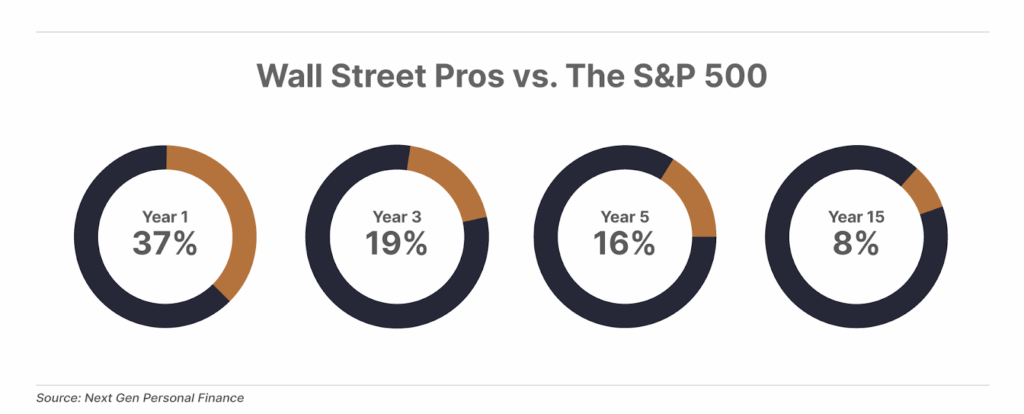
There is something fundamentally wrong with Wall Street. The industry charges high fees and buys and sells way too much.
As Warren Buffett said:
Wall Street is the only place that people ride to in a Rolls Royce to get advice from those who take the subway.”
And I should know… I used to work in the industry myself.
Just hear me out for a second… I managed an equity fund for an asset-management firm. On February 22, 2021, I was pitching the fund to 300 bank managers. I still recall one of the questions I received regarding a company the fund invested in that makes bicycle parts and fishing gear:
Pieter, I see your fund invested $10 million in Shimano. What’s the key investment thesis for this company?”
I froze for a second. I wanted to give him the honest answer. But then I saw my boss in the crowd. So I started building up my case on stage: Shimano dominates the market for bike gear, the company is still family-led, it has a healthy net cash position…
The person who asked the question was satisfied.
But me? I felt terrible.
The real reason we invested $10 million in Shimano for the fund was not because of those reasons. We invested in Shimano because my boss was a cyclist – he loved Shimano.
You read that right… We invested $10 million of our clients’ money because my boss loved cycling.
The results speak for itself: Our $10 million investment in Shimano is now worth $7.6 million.
If you compare this with the results of the S&P 500, it gets even sillier:
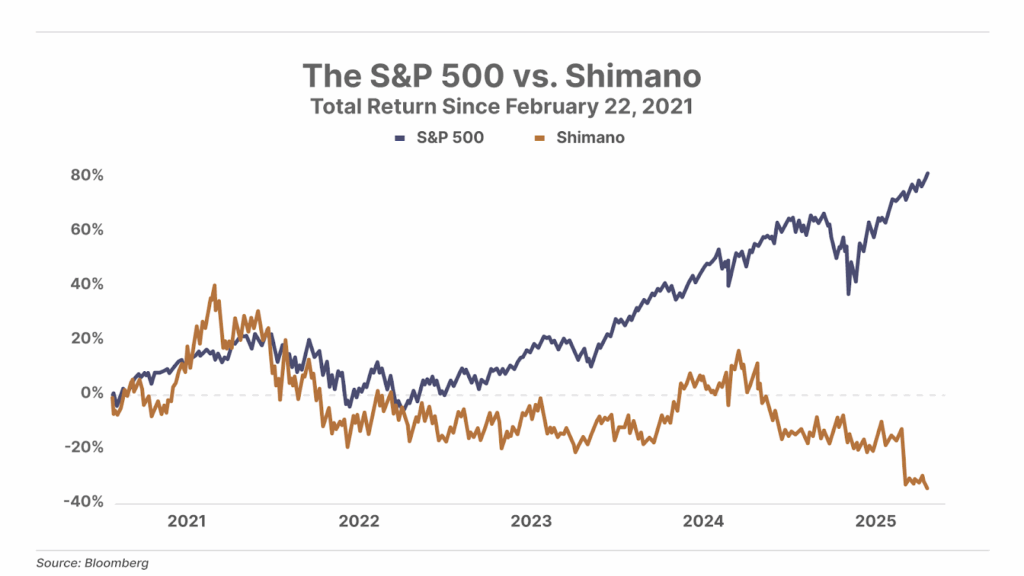
If we invested this money in the S&P 500 instead, our clients’ $10 million would have grown to almost $20 million over those five years.
That’s a $12.5 million loss – just to feed one man’s ego.
Thinking about it still makes me feel sick.
It’s exactly why I left the asset-management industry in 2022.
I want to genuinely do the right thing and help investors like you build intergenerational wealth. Just like Porter does.
Investing is simple… but it’s not easy.
As Albert Einstein beautifully said:
Everything should be made as simple as possible, but not simpler.”
Some strategies just crush the market over time:
- Value investing: up 3.2% per year versus the S&P from 1957 to 2006
- Small caps: up 4% per year versus the S&P from 1926 to 2006
- Quality investing: up 4.2% per year versus the S&P from 2000-2025
If you combine both small caps and quality, something magical happens.
If you invested $1,000 in 1926 it would’ve turned into:
- Large caps: $8.7 million
- Small caps: $430 million
- Micro caps: $860 million
- High-quality micro and small caps: $1.26 billion
By investing in forever stocks in the small-cap space you massively outperform the market.
Now the million-dollar question is how to find these kinds of companies.
It’s pretty easy. You start by using a stock screener.
I tried everything. Made mistakes. Kept tweaking.
After hundreds of hours, I found the key filters.
- Market cap – less than $3 billion market cap… small companies outperform
- Net debt / EBITDA less than 3… healthy balance sheet
- No extra shares issued in the past three years… we don’t like dilution
- Net profit margin greater than 10%… high profitability
- Return on invested capital (“ROIC”) greater than 15%… great capital allocation skills
- Five-year average revenue growth greater than 9% per year… attractive growth
- Five-year average earnings per share (“EPS”) growth greater than 11% per year… attractive growth
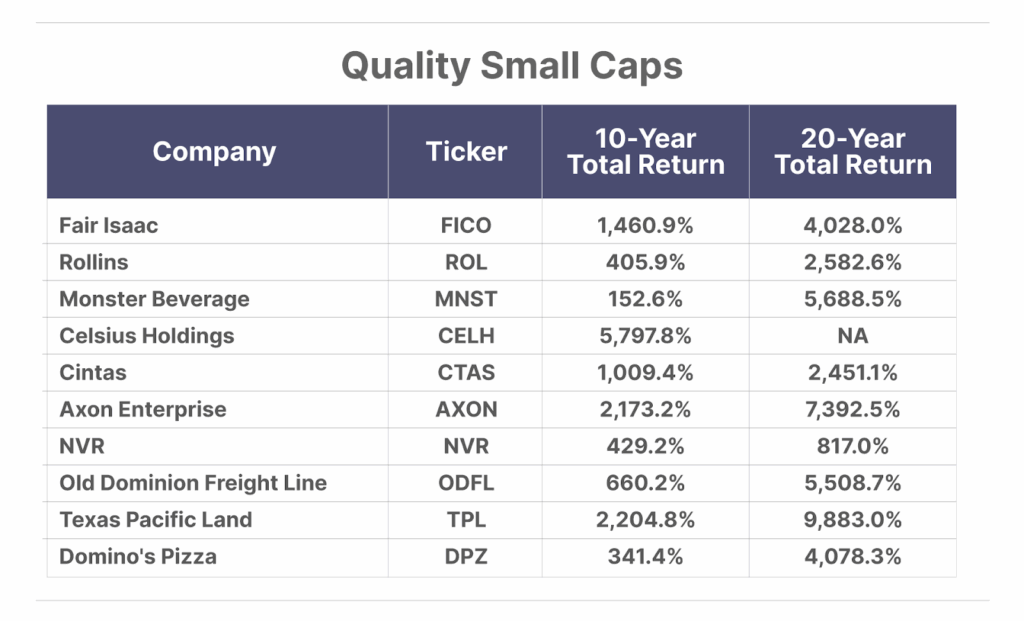
Using these filters, you would have identified companies like Fair Isaac (FICO), Texas Pacific Land (TPL), and Axon Enterprises (AXON) 20 years ago:
And today? Over 250 companies match these criteria. I’m quite sure some of them can 100x over the next 20 years.
Here are 10 examples that pass every filter today:
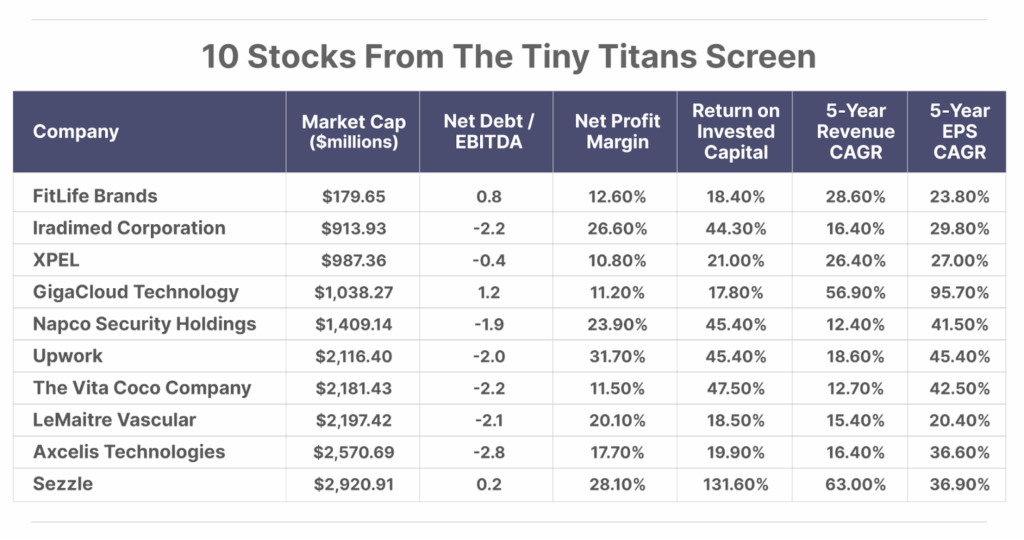
I love every single company in this list.
FitLife Brands (FTLF), The Vita Coco Company (COCO), and LeMaitre Vascular (LMAT) stand out to me.
These are quality small caps you can own forever. Companies that will make money for you while you sleep.
I genuinely believe these 10 stocks have the potential to double every five years.
I’m very curious to find out which company in this list will be the first 100x.
Everything in life compounds,
Pieter Slegers
White House Insider Buck Sexton:
“Trump’s Next Move Will Shock The World”
It could single-handedly reshape the global order… dramatically increase U.S. power… and trigger a massive American market boom the likes of which we haven’t seen in 75 years.

Three Things To Know Before We Go…
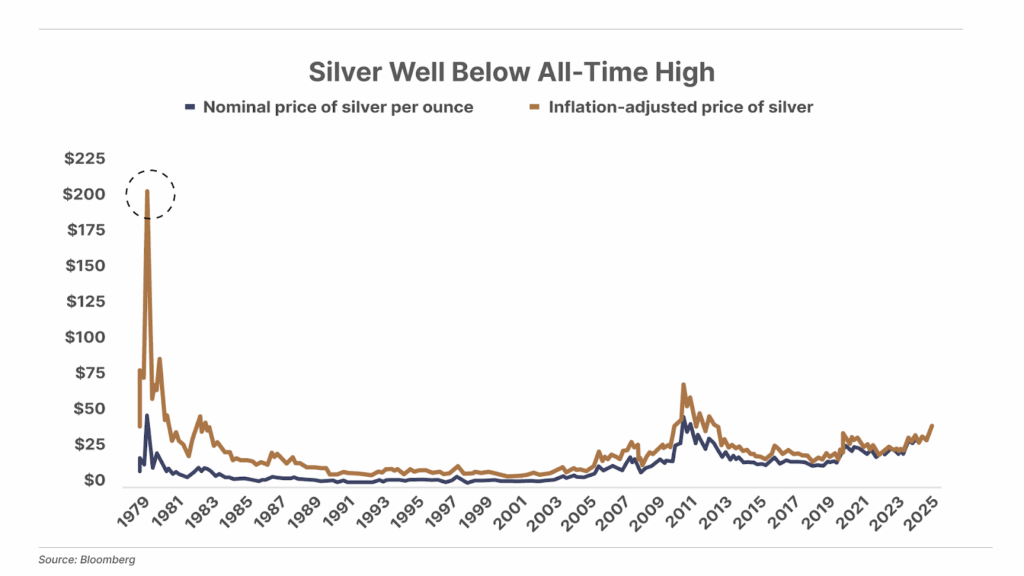
1. Silver has a lot of catching up to do. On Friday, we noted gold had finally reached a new inflation-adjusted high. However, while silver – currently trading around $42 per ounce – is closing in on its nominal all-time high near $50, it remains well below its high when adjusted for inflation. As the chart below shows, when accounting for consumer price index (“CPI”) inflation, silver would need to trade above $200 per ounce to reach its peak set in 1980.
2. A big potential change to corporate reporting. Since 1970, all U.S. public companies have been required to file quarterly earnings reports. President Donald Trump wants to change that. In a Truth Social post this morning, the president proposed – “subject to SEC approval” – altering the rule to require companies to file only every six months instead. He cited lower costs for companies as well as incentivizing corporate America to take on a longer-term outlook, noting “China has a 50 to 100 year view on management of a company whereas we run our companies on a quarterly basis.” While this would represent a significant change for companies, it would align U.S. policy with most other world economies, including the U.K. and the E.U.
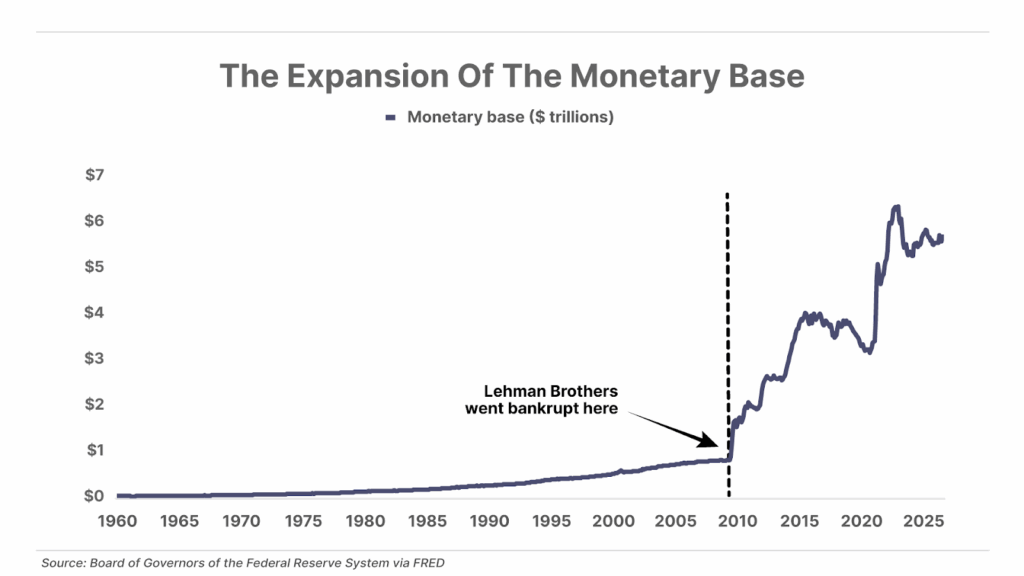
3. Seventeen years ago today, Lehman Brothers collapsed – and the economy has never been the same. The investment bank’s failure exposed deep structural weaknesses in the global financial system and triggered a crisis that demanded extraordinary intervention. To stabilize markets, the Federal Reserve expanded the monetary base (money created by the central bank) from $850 billion in 2008 to $4 trillion by 2014, and to $6.4 trillion by 2021. These actions came with tradeoffs: inflated asset prices, widening inequality, and reduced policy flexibility. While critical at the time, the measures left permanent scars on markets – raising questions about the long-term costs of intervention.
And One More Thing… The Bull Market Rages On
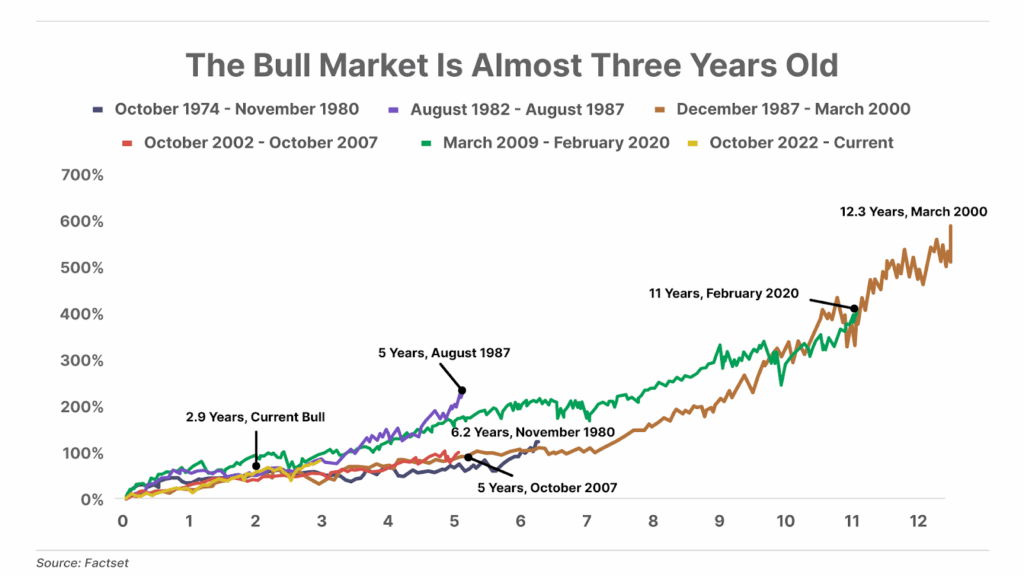
The current bull market is now approaching its third year – and history suggests it could have much further to run. Over the past five decades, bull markets lasting more than two years have gone on to last eight years, on average, with gains of 288%. As this cycle nears its third anniversary in October, conditions remain supportive: inflation is running hot, and the Fed is likely to lower rates.
Tell me what you think: [email protected]
Good investing,
Porter Stansberry
Stevenson, Maryland
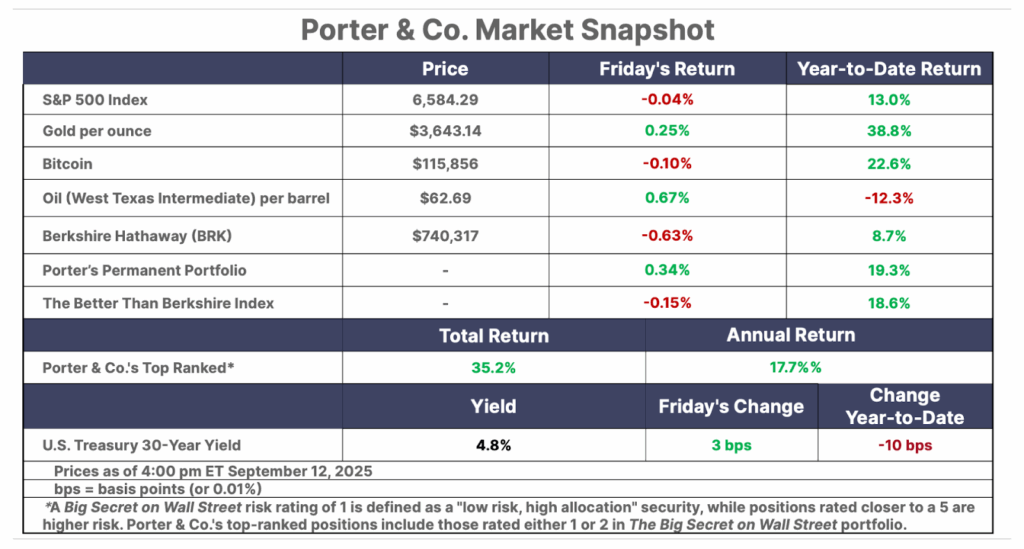
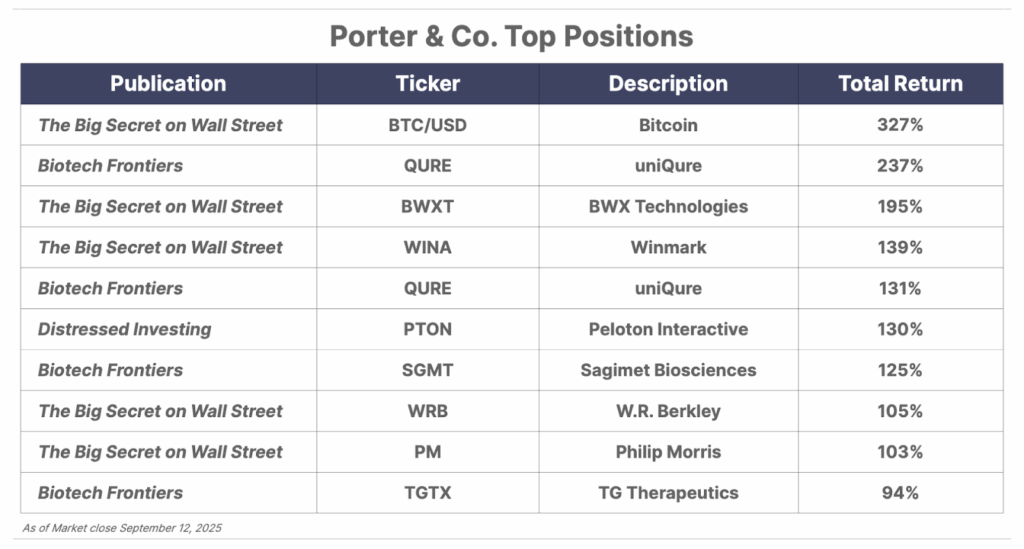
Please note: The investments in our “Porter & Co. Top Positions” should not be considered current recommendations. These positions are the best performers across our publications – and the securities listed may (or may not) be above the current buy-up-to price. To learn more, visit the current portfolio page of the relevant service, here. To gain access or to learn more about our current portfolios, call our Customer Care Team at 888-610-8895 or internationally at +1 443-815-4447.