Issue #3, Volume #3


Even After A 65% Gain, The Precious Metal Has Room To Run
This is Porter’s Daily Journal, a free e-letter from Porter & Co. that provides unfiltered insights on markets, the economy, and life to help readers become better investors. It includes weekday editions and two weekend editions… and is free to all subscribers.
|
Up 65% in 2025… Up 2x in two years… Safer than nearly every other asset… Central banks are scooping it up… Porter’s third “all in” moment… Interviewing the #1 expert on the topic… A Venezuela oil update… |
You ain’t seen nothin’ yet.
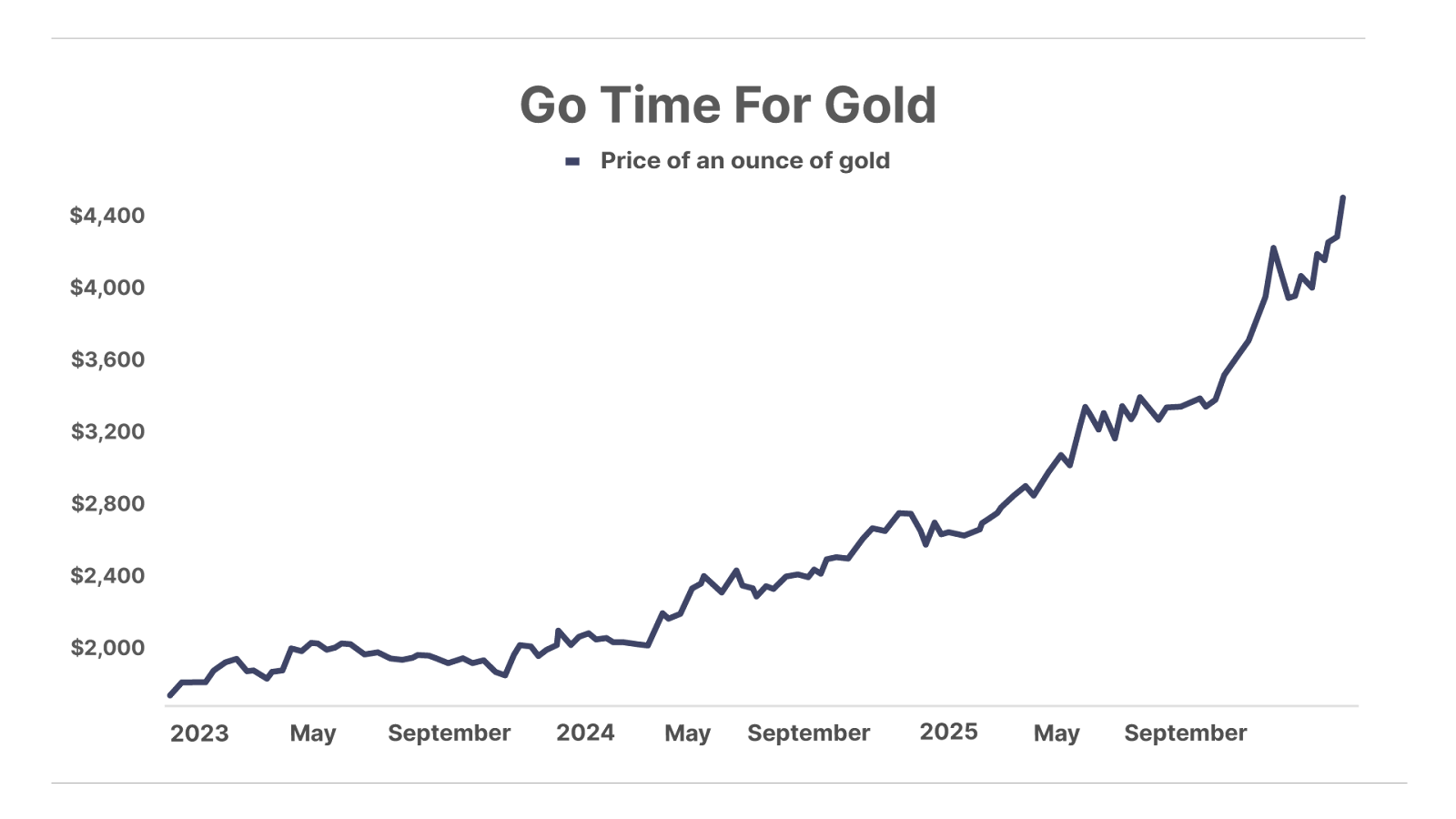
The price of gold has increased 65% over the last year – starting out 2025 at $2,600 per ounce and ending at $4,400… And it’s got room to grow.
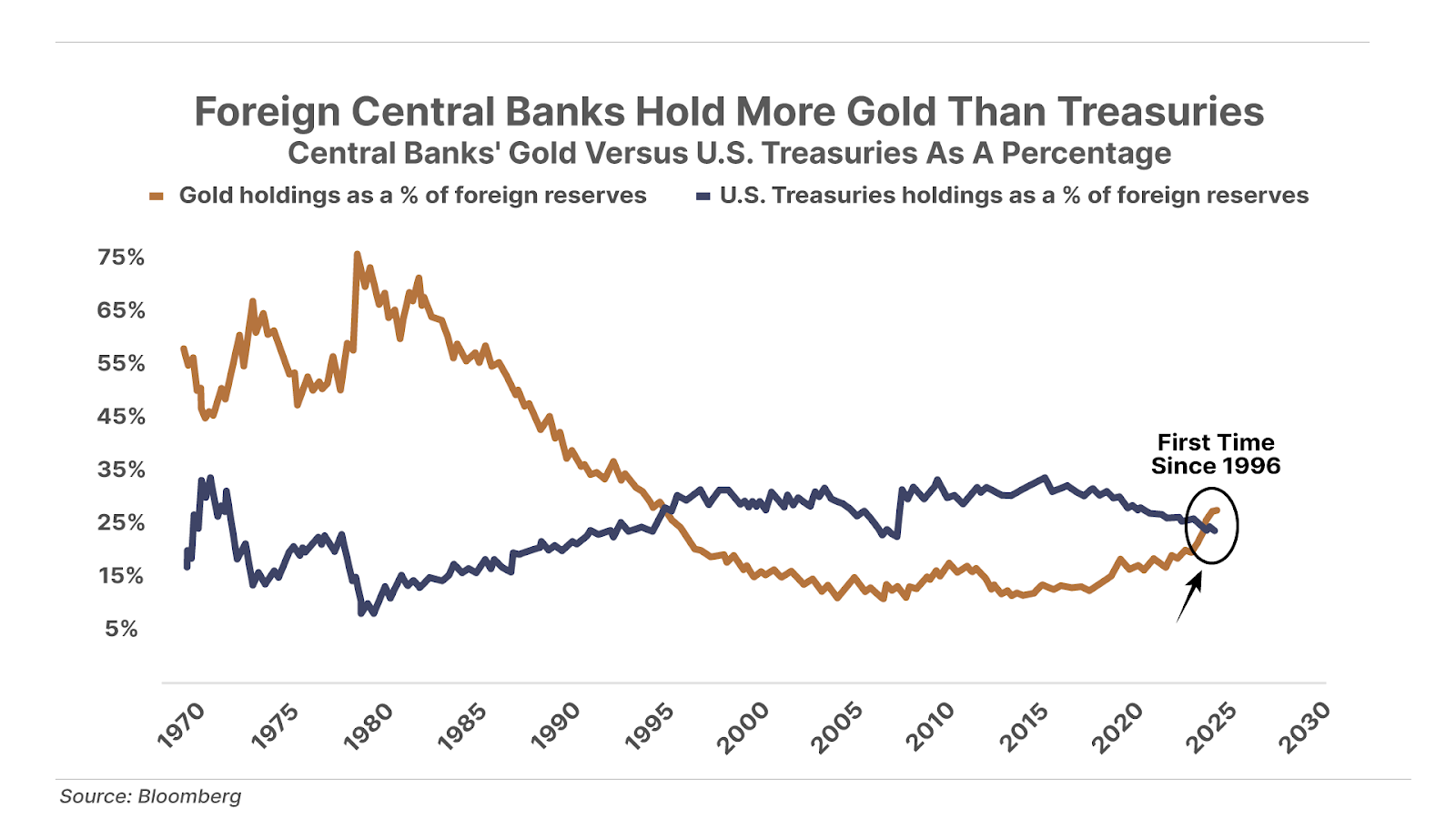
As we reported regularly in the Daily Journal last year, for the first time in nearly 30 years, foreign central banks hold more gold than U.S. Treasury debt as a percentage of reserves. As the chart below highlights, this shift from Treasuries to gold began roughly 10 years ago, and accelerated after the U.S. seized Russia’s reserves following the start of its war with Ukraine. If gold is resuming its role as the world’s preferred reserve asset, history suggests it has much further to run.
Let’s briefly look at why this is happening.
Gold’s physical durability is one reason for its value to investors. The metal is so chemically stable that it is virtually impossible to destroy. And unlike many other commodities, only a relatively small proportion – about 3% – of gold is used in industry.
This combination of traits means most of the gold that has ever been mined is still owned today, giving it an extremely high stock compared to other monetary goods.
This vast, existing stock means producers can only inflate the gold supply by about 1.5% a year. The total amount of existing gold is estimated to be around 200,000 metric tonnes. At the current annual production rate of around 3,100 metric tonnes, this represents a little more than 65 years’ worth of supply – giving gold a stock-to-flow ratio of around 65.
The stock-to-flow ratio is one of the best ways to assess a particular money’s hardness.
This ratio compares the existing supply (or stock) of a monetary good – which includes all that has been produced in the past, less any amount that has been consumed or destroyed – to how much new supply (or flow) can be produced in a given period (typically a year).
The higher the stock-to-flow ratio, the more likely it is to maintain its value over time.
The stock-to-flow ratio for fiat currencies (like the U.S. dollar) is theoretically zero, as there is technically no limit to how much new currency can be created. In practice, the U.S. money supply has increased by about 10% annually since the dollar was officially untethered from gold in 1971. That equates to a stock-to-flow ratio of roughly 10.
Because so much gold already exists, even if new gold production were to double overnight – which it won’t – it would result in only a 3% annual increase in total supply. Meanwhile, the simultaneous growth in gold’s existing stock would make each additional annual increase less significant, even if that rate of production is maintained.
In other words, unlike most other monetary goods, it is practically impossible to create enough new supply to suppress the price of gold significantly.
Among commodities, only silver comes close to rivaling gold. Its stock-to-flow ratio is around 22 – indicating one-third the hardness of gold.
One other reason for owning precious metals is based on the same basic ideas Porter has written about for the last 15 years, most famously in his End Of America thesis – the runaway train of America’s debt and deficits is leading to the eventual insolvency of the U.S. federal government.
With U.S. federal debt now exceeding 130% of GDP, and the government’s $1 trillion-plus annual interest bill surpassing the entire U.S. defense budget, America’s descent into insolvency continues.
The smart money has been preparing for this outcome for years. Starting in 2020, global central banks began dumping U.S. Treasuries in favor of gold.
And even though gold now makes up a larger portion of foreign central bank reserves than U.S. government bonds, this trend still has a long way to go.
We believe we’re in the early stages of a reset in the post-World War II global monetary order, in which hard money – like gold – ultimately replaces the U.S. dollar and U.S. Treasuries as the bedrock of the international monetary system. This trend began after the 2020 COVID money-printing spree, best shown in the chart below where Treasury bonds collapsed as gold soared in value:
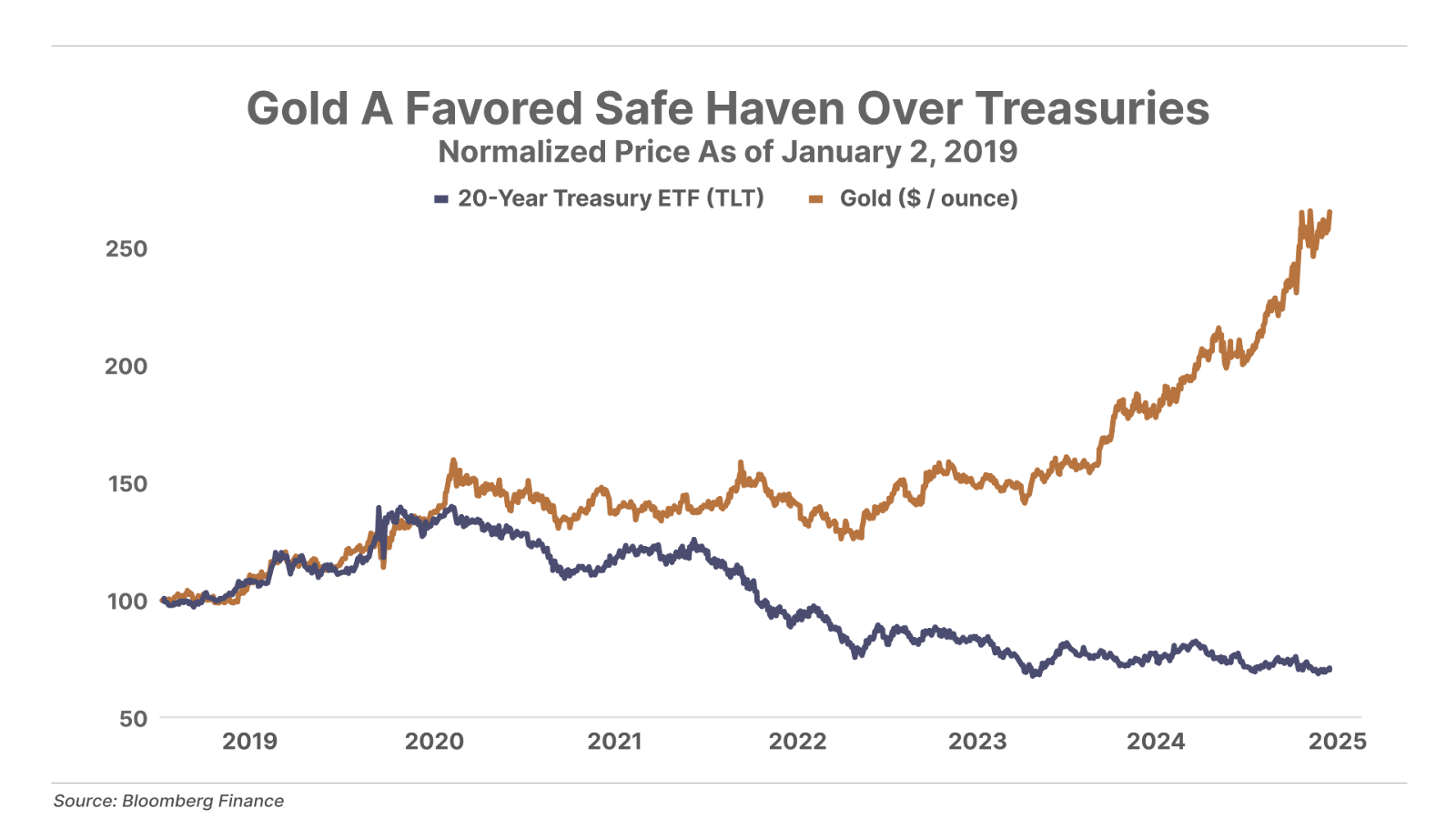
The reasoning is clear: instead of buying into government bonds as the safe-haven asset, global investors are piling into gold, which broke out to record highs above $2,100 per ounce in March 2024, and has since rallied more than 2x to $4,400 per ounce. Gold is the new global safe-haven asset, as investors flee into it and away from the promissory notes of overly indebted governments around the world.
That’s why Porter has been big-time bullish on gold for a little more than a year. In fact, now is the third time over the last 30 years that Porter has followed what he calls “the go all-in” message on gold.
The first time was back in the 2000s – the dot-com mania was nearing its peak, money was flooding into any and all tech stocks, and equity valuations were way above where they should have been. At the time, gold was despised by Wall Street – Goldman Sachs called it “a 19th-century asset” and a top Merrill Lynch analyst said that it was only for “grandmothers and conspiracy theorists.”
Yet, Porter chose to buy at under $300 an ounce.
The second all-in signal came in 2008 when, amidst the chaos of the Global Financial Crisis, the price of gold slid into the $700-an-ounce range – and Porter jumped in big time.
Then, as we said, again in 2024 – Porter moved roughly 50% of his liquid net worth into gold and Bitcoin.
Porter explains his high conviction on gold this way…
I had an edge. Austrian economist Kurt Richebächer taught me a formula for calculating gold’s projected price range with near 100% accuracy. It’s a formula that I believe was the key to some of the biggest, oldest fortunes on the planet: The Medicis of Florence, the Rothschilds and Warburgs of Germany, and the House of JP Morgan…
By using the data aggregated in this formula, I believe they were able to reliably predict changes in asset prices like commodities, currency rates, real estate, and, of course, gold… A skill that handed them nearly unlimited economic power and wealth. And that I’ve been able to time my gold purchases with incredible accuracy over the last 30 years.
Porter used the algorithm to help him determine that the time to buy gold was a little over a year ago, a decision that he says has paid off exceptionally well:
And he believes gold will continue to perform well in 2026…
The algorithm creates a range of gold’s price in three years’ time. Here’s the predicted range of the actual price of gold (in January) since 1980.
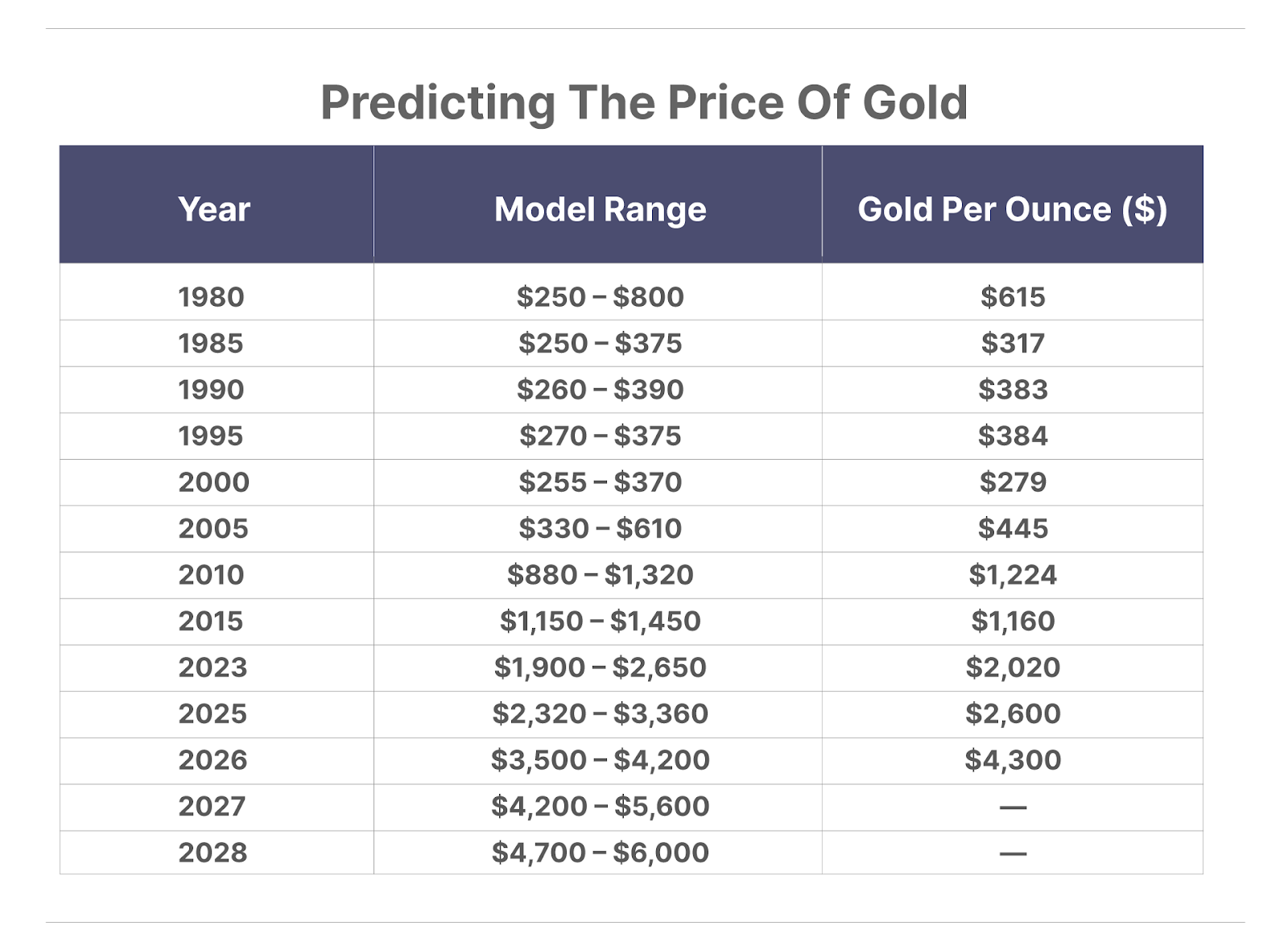
By the end of 2026, gold will be above $4,000 per ounce. And by the end of 2027, gold will be above $4,700… and perhaps around $6,000.
At the start of 2025, Porter knew gold would most likely double over the next three years. More important, he knew it wouldn’t go lower. It’s easy to push your chips into the pot when you know you’ve got winning cards.
Porter has just released an interview with the world’s leading expert in precious-metals investing in an effort to tell readers the number-one way to capitalize on gold’s bull run… Hint: it’s not gold-mining stocks.
No, it centers around a part of the gold market that few retail investors fully understand, yet it has outperformed almost every asset class over the last two decades.
And as gold continues to rally higher, this investment will likely continue to dominate all other assets.
In this recent interview, Porter unpacks everything for you – including what’s happening in the gold market, gold’s next move, and the best way to play it. Click here to watch the interview.
Three Things To Know Before We Go…
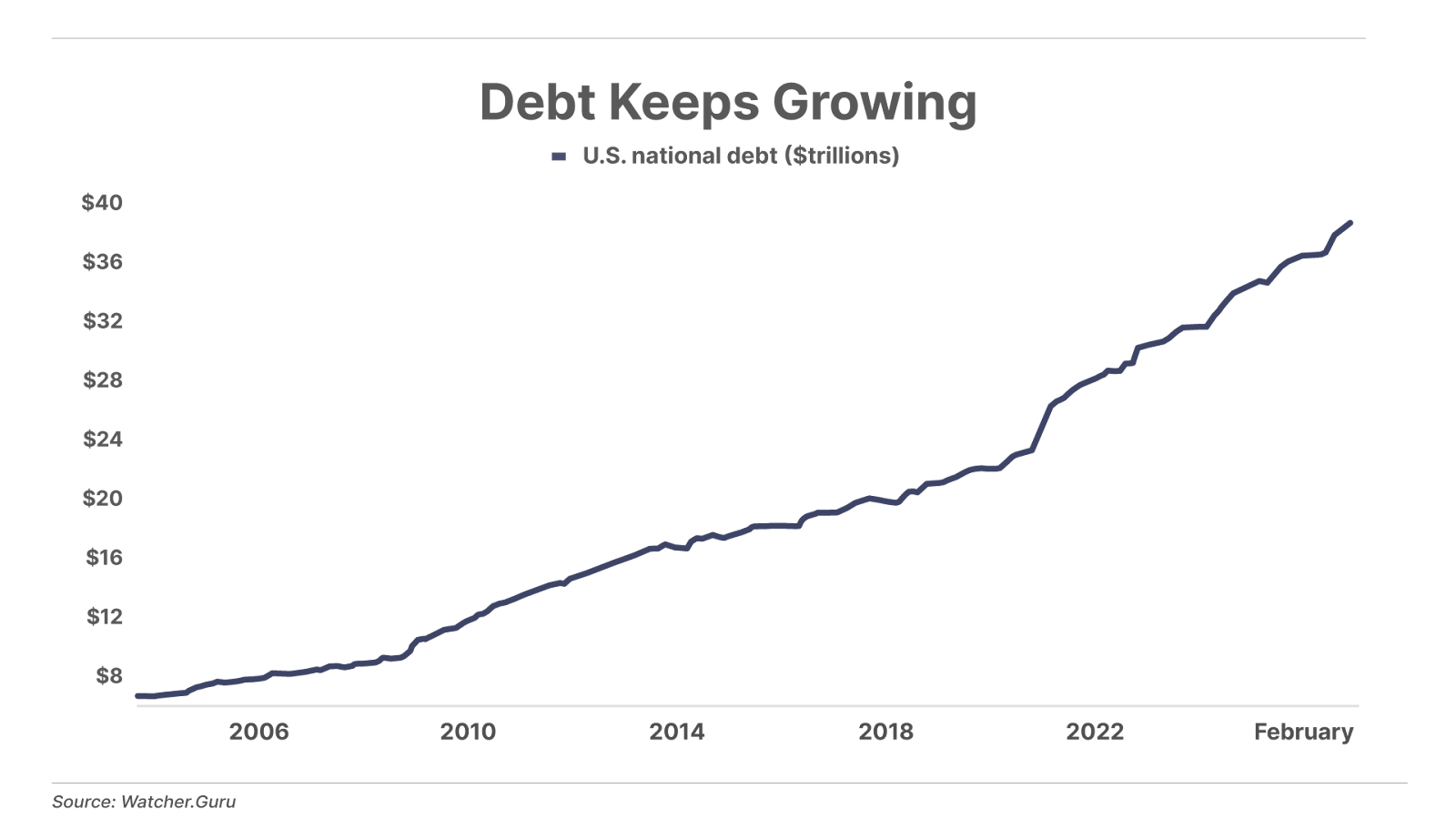
1. U.S. debt is soaring with no sight of stopping. Total federal debt surpassed $38.5 trillion, surging by more than $2.2 trillion in 2025 – an average accumulation of $6.1 billion per day. Since 2020, the U.S. has issued over $15 trillion in new debt, meaning nearly 40% of the total national debt was created in the last six years. In 2025, net interest payments hit $1 trillion, surpassing national defense spending to become the second-largest federal expense. With interest now consuming 19% of all federal revenue, the Treasury is increasingly reliant on debt issuance as concerns intensify that the government’s only way out is to devalue the currency.
2. The White House executes “Operation Absolute Resolve.” In the historic and unprecedented military mission over the weekend, the Trump administration captured Venezuelan leader Nicolás Maduro and his wife, Cilia Flores. The operation was reportedly the culmination of months of planning by U.S. Special Operations Command, and marked the first time a foreign head of state has been forcibly removed and brought to the U.S. for trial since Panama’s Manuel Noriega in 1989. The couple faces charges of narco-terrorism, cocaine importation conspiracy, and weapons offenses. President Donald Trump has since declared that the U.S. would effectively “take control” of Venezuela during a transition period to ensure stability, a move that pundits are calling the “Trump Corollary” to the Monroe Doctrine, signaling a renewed U.S. stance on removing perceived security threats from the Western Hemisphere.
3. No Venezuelan oil boom anytime soon. The news of President Trump’s plan to “take control” of Venezuela’s vast oil resources sparked a rally in stocks of U.S. oil companies that would likely develop those resources, like Chevron (CVX), while punishing shares of companies focused exclusively on U.S. shale, like our favorite royalty play Viper Energy (VNOM). The apparent calculation by Mr. Market is that a flood of production from Venezuela will take market share from U.S. shale producers. But there’s three reasons why we believe this view is misplaced: 1) Venezuela’s production infrastructure is dilapidated after decades of neglect, and full production potential would take a decade and over $100 billion of investment. 2) Most of Venezuela’s oil is extra-heavy sour crude that requires complex, expensive “upgrader” facilities that are currently in shambles. And 3) The world is currently awash in cheap crude oil, limiting the upside case for deep-pocketed supermajors, especially given the risks involved. In short, it will be many years before we see any meaningful increase in Venezuelan crude oil exports. Thus we view the recent sell-off in U.S. shale producers like Viper Energy (VNOM) as an attractive buying opportunity.
Porter Stansberry
Stevenson, Maryland
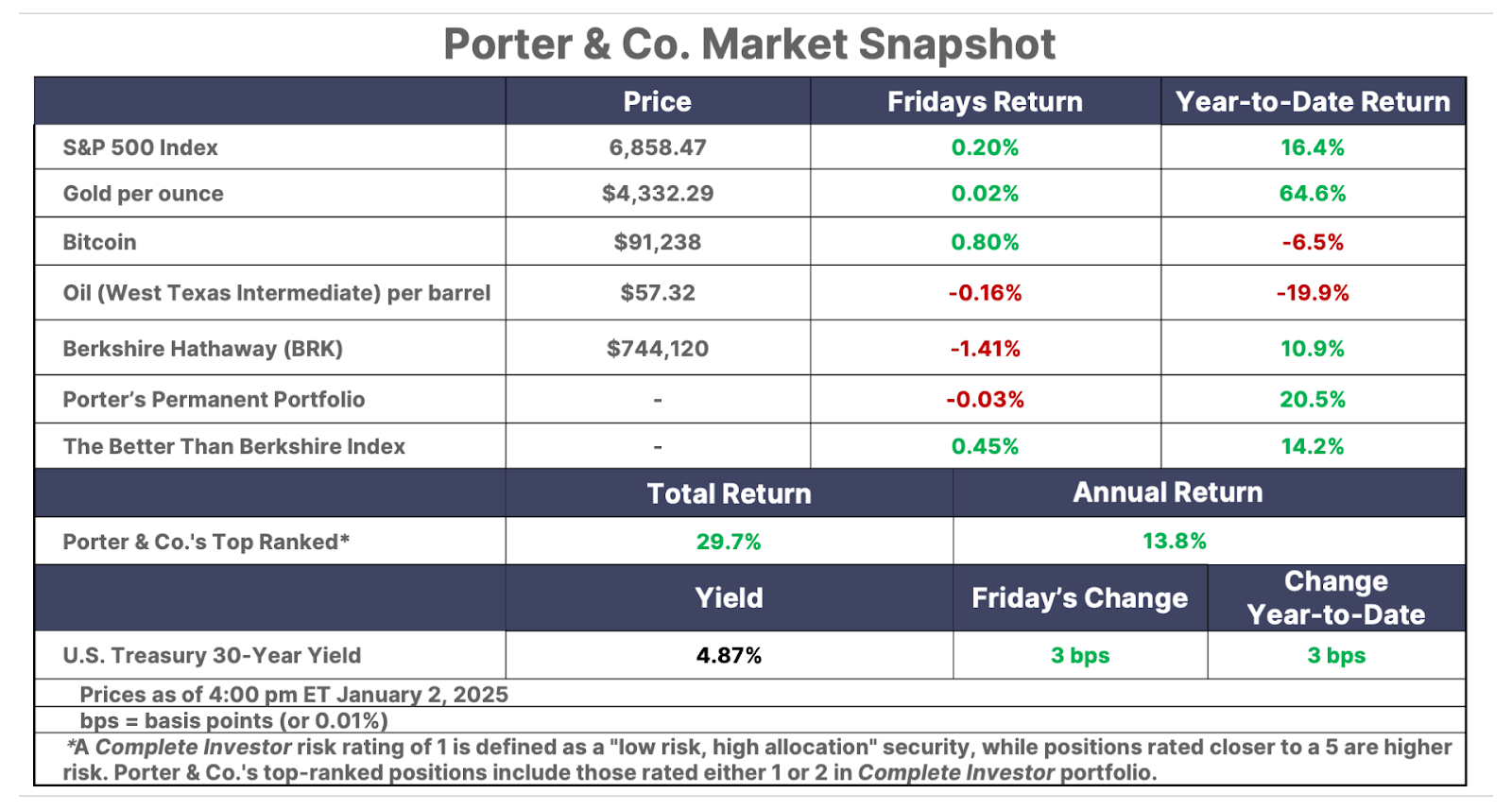
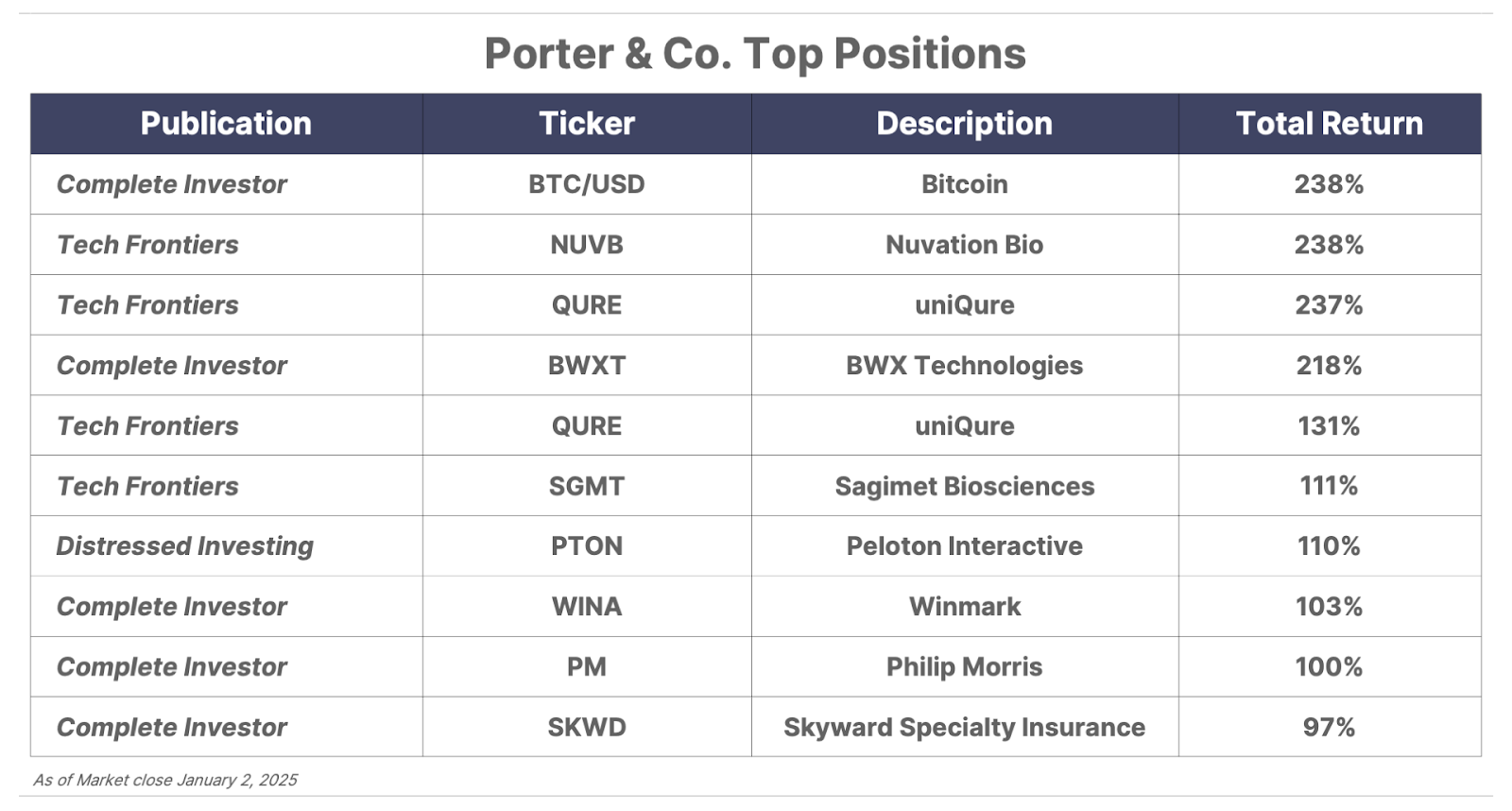
Please note: The investments in our “Porter & Co. Top Positions” should not be considered current recommendations. These positions are the best performers across our publications – and the securities listed may (or may not) be above the current buy-up-to price. To learn more, visit the current portfolio page of the relevant service, here. To gain access or to learn more about our current portfolios, call our Customer Care team at 888-610-8895 or internationally at +1 443-815-4447.