Issue #145, Volume #2


The Last Of Our Annual Report Cards
This is Porter’s Daily Journal, a free e-letter from Porter & Co. that provides unfiltered insights on markets, the economy, and life to help readers become better investors. It includes weekday editions and two weekend editions… and is free to all subscribers.
We’re devoting this week’s Daily Journals to a practice that Porter has been doing for decades… issuing Report Cards for the newsletters that he publishes. Honest and thorough feedback is the key to earning trust and ensuring straightforward financial analysis and recommendations. As Porter likes to say: it’s the information I’d like to receive if the roles were reversed.
Today, we complete the grading with our remaining advisories – The Trading Club, Asymmetry, and Porter’s Permanent Portfolio.
Porter takes over with his final Report Cards below.
|
Day 3 of Report Cards… Trading Club performing well… Asymmetry getting upside gains… Porter’s Permanent Portfolio has higher returns and low risk… Keeping us honest… Making us better… |
In May, we launched The Trading Club, with analyst Ross Hendricks taking the lead.
The Trading Club is a great example of how we try to constantly evolve to meet the needs of our subscribers. Readers are interested in being more active with their portfolios, but don’t really know where to begin, and many don’t know how to make trades safely.
You wouldn’t believe how many emails I get from readers asking about income… another topic readers are interested in. Hundreds of them. Because that’s what most folks want as they get older. Plus, a lot of our readers are retired or getting close, and they’re not chasing home runs anymore – they want reliability, predictability.
So we can’t afford big risks. We want to use options the way professionals do. To take away the mystery… and make it about income first, upside second.
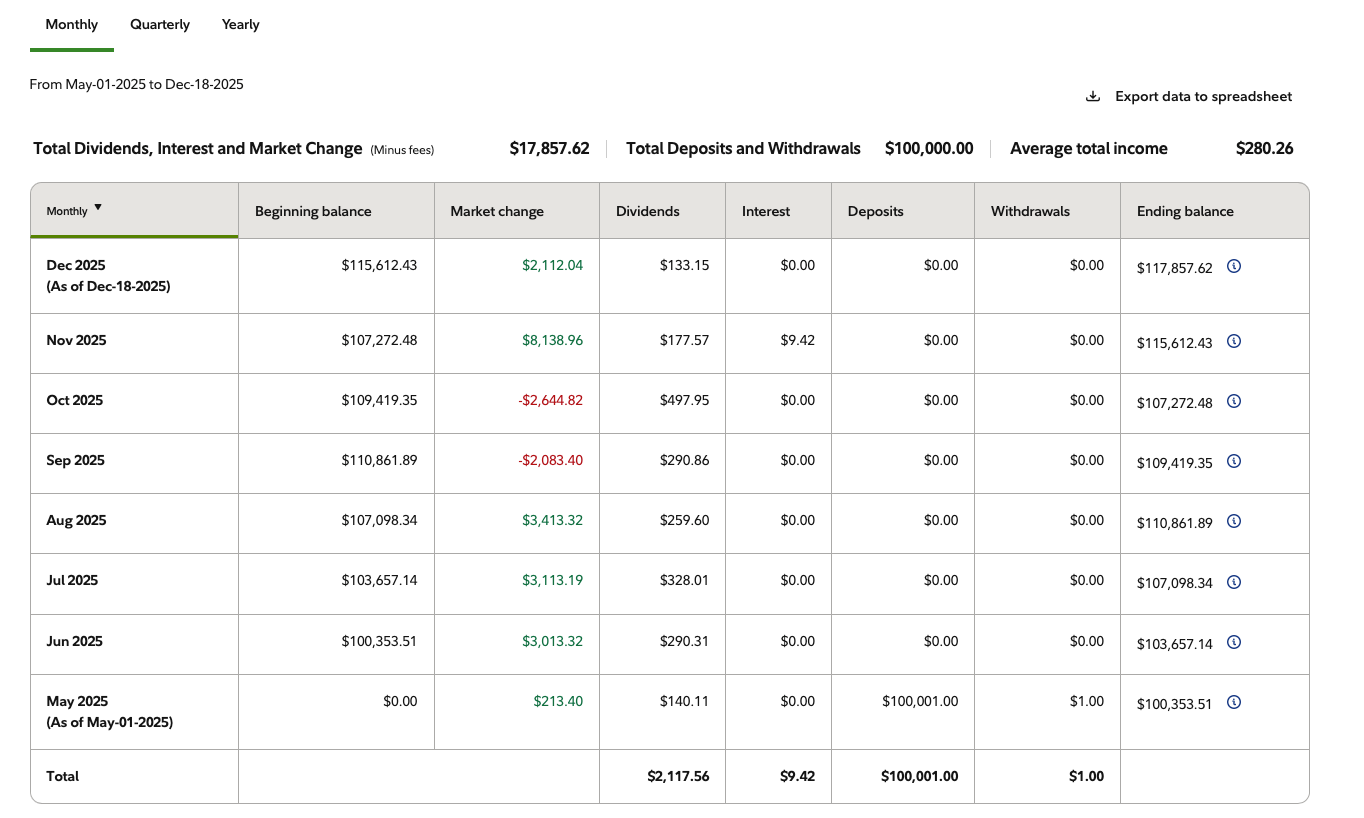
Ross did a brilliant job of that. As of yesterday’s closing prices, our live tracking portfolio is up 17.9% since our May 30 launch date.
And when the time is right, we’ll also be adding high-confidence trades from The Trading Club. These are the moves that bring a little more steady income to the portfolio.
As many of you might know, I’ve done really well this year selling puts, the same core strategy behind most of The Trading Club picks. Selling puts is a great way to generate income or get great entry prices on stocks I want to own.
In many cases, the puts we’ve sold have expired worthless – meaning we pocketed a 100% gain simply from promising to buy stocks we like at future discounted prices. Notable examples of closed trades include:
-
Sold two puts on The Hershey Company (HSY), each for 100% gains, collecting $1,839 in income
-
Sold one put on PepsiCo (PEP) for a 100% gain, collecting $569 in income
-
Sold two puts on Celsius (CELH) for a 100% gain, collecting $579 in income
In other cases, the puts we’ve sold have expired “in the money” – meaning we ended up buying shares at attractive prices. This includes a put sale in Philip Morris International (PM), which allowed us to acquire shares at a cost basis of $152.82.
Options can also allow us to make huge gains on high-quality stocks where there is a certain catalyst for the shares to move higher. Take British American Tobacco (NYSE: BTI). We bought calls on it and are currently sitting on a gain of over 200%. That’s using options intelligently – and on a defensive stock.
And on the other side of the ledger – our put trade on the Invesco QQQ Trust (Nasdaq: QQQ), which mimics the Nasdaq 100 Index, is designed as a hedge against a bear market. We reinvest a small portion of the income generated from option sales into these “insurance contracts” designed to offer protection against a market crash. Most of these contracts will expire worthless, costing us around 1% to 2% of our portfolio capital. However, we expect these to pay off by a factor of 10x or more in the event of a market meltdown, which lets us remain invested with a safety net.
This approach is designed to generate consistent income and high returns during bull markets, while also providing protection against bear markets. The end goal is to create a durable portfolio that can outperform in any market environment.
So far, we’ve proved we can outperform in a bull market. And we believe we can do the same when today’s bull market inevitably ends… and the next bear market begins.
Porter’s 2025 Grade: Ross gets an A from me for his work with The Trading Club.
Many folks reading this are unlikely to be familiar with Porter & Co.’s Asymmetry – it’s a publication we put out just for our Partner Pass members. Asymmetry is one of those oddball publications. It doesn’t have a set schedule… The entire premise of Asymmetry is very simple: find those rare setups where the upside is enormous, but the downside is tightly defined. They don’t come around often. But when they do, you can really hit it big.
Naturally, not all of those recommendations work out. Just last week, we removed Burford Capital (NYSE: BUR) from Complete Investor as well as from Asymmetry, because it didn’t perform as expected and we didn’t see great potential going forward… but our Asymmetry recommendations of Fannie Mae (OTC: FNMA) and Freddie Mac (OTC: FMCC) are both up around 70% since February – when I predicted that U.S. President Donald Trump would take them out of conservatorship.
These are the largest mortgage companies in the world, and the government is keeping all of their earnings. President Trump is talking about spinning them back off to the public, and if that happens, they could very well be worth multiples of what they are today.

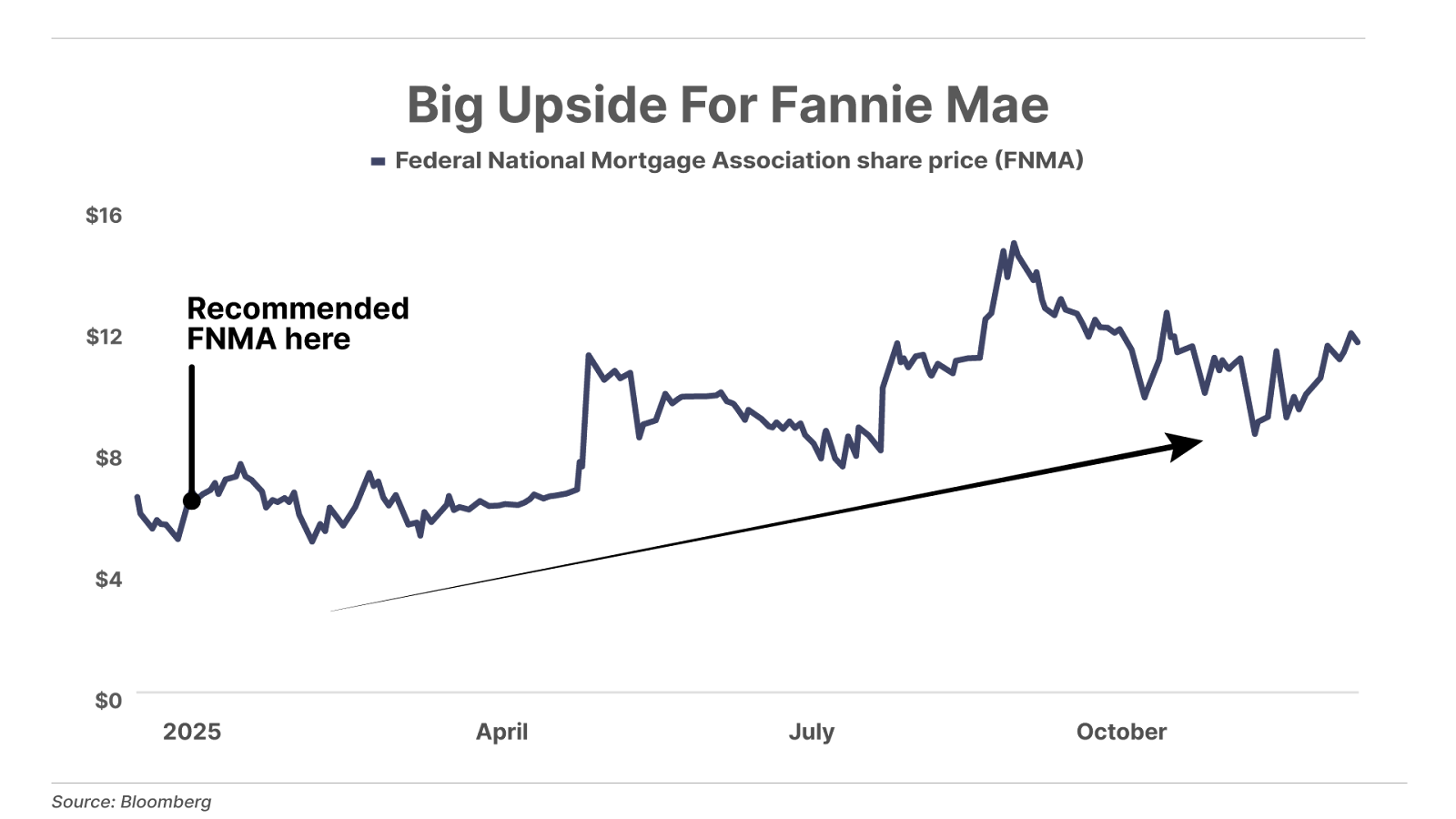
We recommended them trading for less than $10. There wasn’t much downside in the situation – but there’s potential for huge upside… and that’s what made them a perfect fit for Asymmetry.
That’s the beauty of Asymmetry. You don’t need a dozen wins. You just need a handful of the right ones.
Porter’s 2025 Grade: I’ll give us an B+ for our work in Asymmetry.
And, finally, that leads us to Porter’s Permanent Portfolio, which we launched at our 2024 Annual Conference, and then re-balanced and presented once again at our Annual Conference earlier this year.
It’s been exceptional, performing exactly as it was designed to… Great returns – better than anticipated – with far lower volatility than the broader market. The beauty of this portfolio is that it is built to weather all the chaos out there.
And that makes sense, because I didn’t build Porter’s Permanent Portfolio to be clever… I built it so your future doesn’t depend on good stock picking. No drama, no big risks – just steady and relentless progress.
I’m happy to learn that lots of subscribers out there are using the Permanent Portfolio. In fact, one subscriber wrote in recently to say:
[I] manage my $20M equity portfolio through your permanent portfolio now, and sleep better than ever.
That speaks for itself.
It almost doesn’t make sense to grade Porter’s Permanent Portfolio in any individual year, because the whole point is that it just runs and runs forever… and will be a battleship over time.
That said, we’re up around 20% for the year, slightly ahead of the S&P 500. And, of course, with far less volatility. Our beta – that’s the portfolio’s monthly volatility compared to the market’s – is less than half the S&P 500’s. In short, it’s going great.
Porter’s 2025 Grade: Porter’s Permanent Portfolio gets an A+.
As I said when we began the week: I publish these annual Report Cards because it is important to hold ourselves accountable for our performance. I’m a firm believer that good intentions must be measured against actual results. So I hope that through these Report Cards, you have gotten a better understanding of how our analysts achieve their (mostly) excellent results. This feedback improves their future performance – meaning that Porter & Co. winds up with better products, and you’ll get higher quality research from us in the future.
Three Things To Know Before We Go…
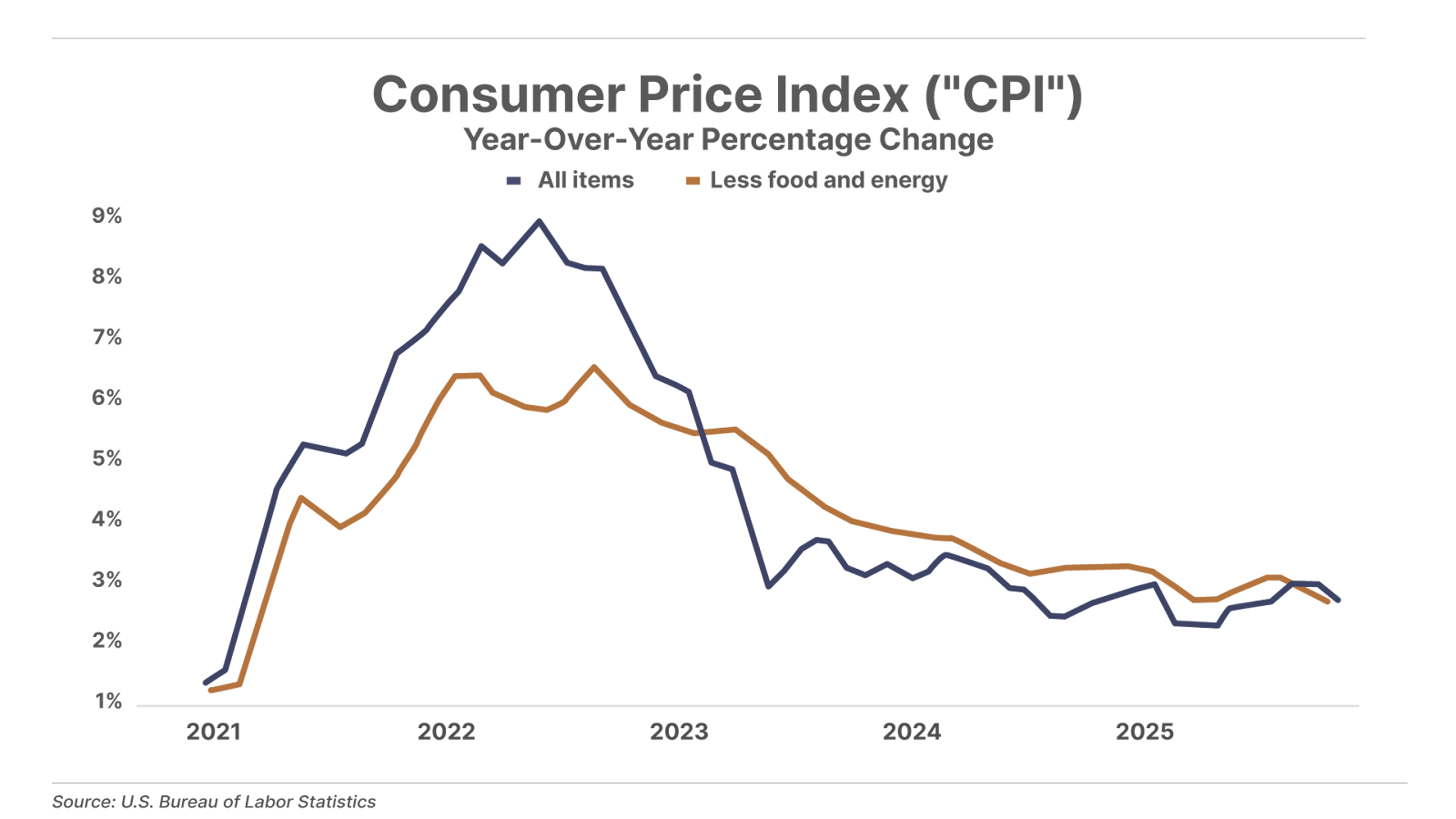
1. The government says inflation cooled sharply, but some economists are skeptical. Yesterday, the Bureau of Labor Statistics (“BLS”) reported the consumer price index (“CPI”) rose at a 2.7% annual rate in November, versus Wall Street expectations of 3.1%. Markets cheered the news, but some economists believe the report may have understated the true rate of price inflation, as the BLS was forced to make “methodological assumptions” because of the government shutdown.
2. The gig economy booms as the real economy weakens. Federal Reserve data show that roughly 20% of workers who have lost a job or suffered a pay cut are turning to gig work – such as driving for Uber or DoorDash – to supplement their income. But gig work typically only covers 50% to 65% of prior earnings. If consumer spending softens more and households cut back on services like ride-sharing and food delivery, even that reduced income will fall. It’s clear that economic growth is increasingly driven by top earners, as more people rely on lower-quality, more fragile income sources to get by.
3. Tariffs and China slowdown mask Nike’s turnaround. Nike (NKE) shares fell 10% following its latest earnings report published last night. Despite beating on the top and bottom lines, tariffs and a weak performance in China caused a sell-off. However, Nike’s North America segment is back in growth mode, with sales up 9% year over year. With Nike’s core segments showing impressive strength, we view China and tariffs as temporary setbacks. The 10% share price decline on the back of this report looks like an overreaction and a buying opportunity.
Tell me what you think of our Report Cards or anything else: [email protected]
Good investing,
Porter Stansberry
Stevenson, Maryland

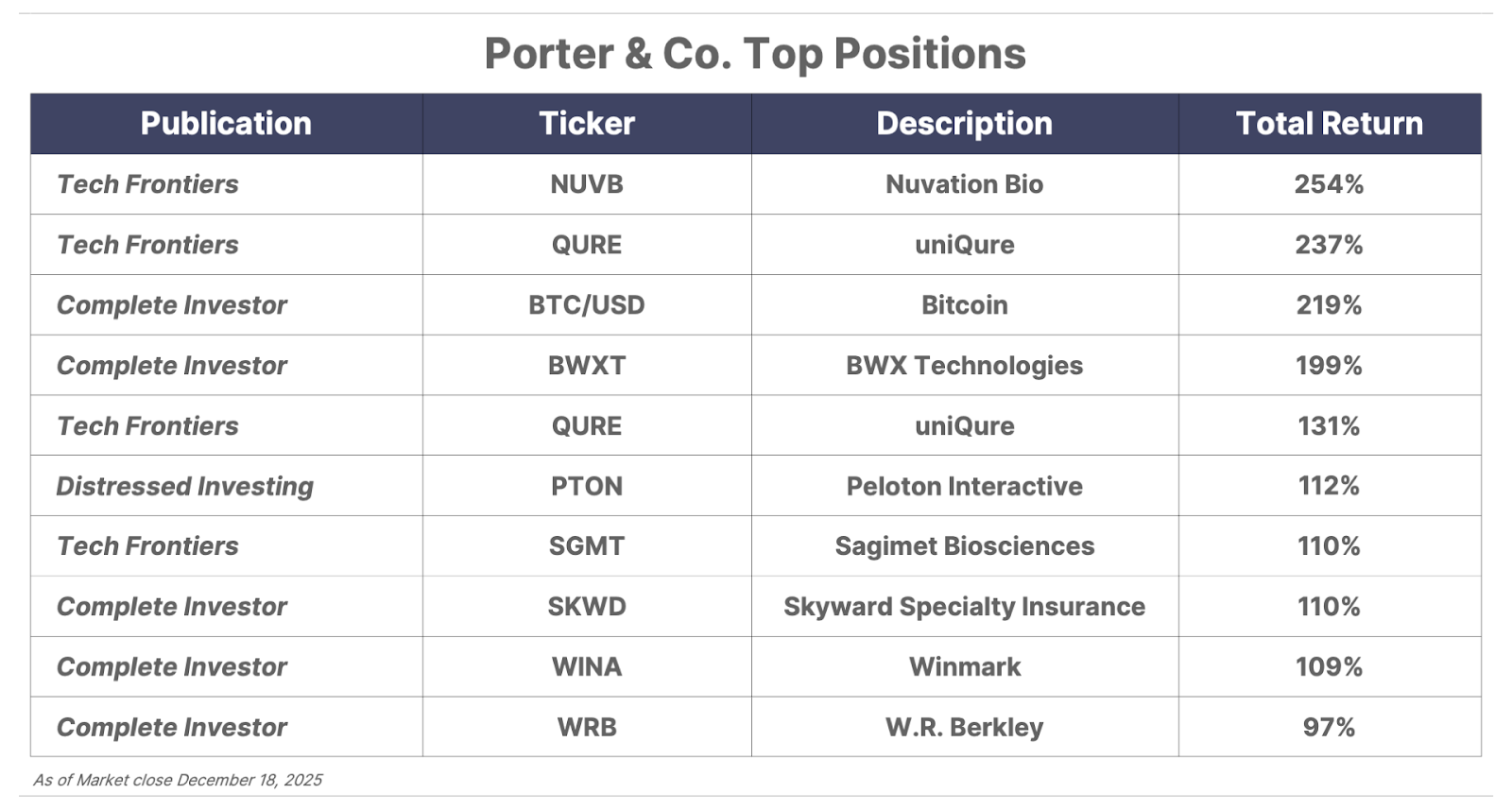
Please note: The investments in our “Porter & Co. Top Positions” should not be considered current recommendations. These positions are the best performers across our publications – and the securities listed may (or may not) be above the current buy-up-to price. To learn more, visit the current portfolio page of the relevant service, here. To gain access or to learn more about our current portfolios, call our Customer Care team at 888-610-8895 or internationally at +1 443-815-4447.